Fintech UX Research
Role
Role
UX Research
UX Strategy
UX Research
UX Strategy
Deliverables
Deliverables
UX Research
Surveys
Affinity Map
Prioritization Matrix
UX Research
Surveys
Affinity Map
Prioritization Matrix
Duration
Duration
4 weeks
4 weeks
Tools
Tools
Figma
Manus
Google Sheets
Figma
Manus
Google Sheets
Industry
Industry
Fintech
Fintech

INTRODUCTION
INTRODUCTION
During a 6 week Agile UX Masterclass, we did several research and design sprints to find out how we can create interactive tools that make learning about financial skills fun and relevant for students. Our research led us to finding new target users and solving a more niched problem.
During a 6 week Agile UX Masterclass, we did several research and design sprints to find out how we can create interactive tools that make learning about financial skills fun and relevant for students. Our research led us to finding new target users and solving a more niched problem.
Problem
Problem
Despite growing financial responsibilities, many students lack practical financial knowledge. Existing financial education tools are often theoretical, disengaging, and disconnected from real-life decision-making.
Despite growing financial responsibilities, many students lack practical financial knowledge. Existing financial education tools are often theoretical, disengaging, and disconnected from real-life decision-making.
How Might We?
How Might We?
Create interactive tools that make learning financial skills fun and relevant for students?
Create interactive tools that make learning financial skills fun and relevant for students?
RESEARCH GOALS
RESEARCH GOALS
Financial Education Findings
Financial Education Findings
To understand how students currently learn about money, what frustrates them, and what would make financial learning feel engaging and useful, we focused on four main goals.
To understand how students currently learn about money, what frustrates them, and what would make financial learning feel engaging and useful, we focused on four main goals.
Understand students' current relationship with financial education (what they know, where they learned it, gaps in knowledge)
Uncover what motivates students to engage (or not engage) with financial learning
Determine what types of interactive experiences resonate most with students
Identify existing pain points or barriers students face when trying to learn financial skills
Understand students' current relationship with financial education (what they know, where they learned it, gaps in knowledge)
Uncover what motivates students to engage (or not engage) with financial learning
Determine what types of interactive experiences resonate most with students
Identify existing pain points or barriers students face when trying to learn financial skills
FOUNDATIONAL RESEARCH
FOUNDATIONAL RESEARCH
Design Sprint 1 & 2
Design Sprint 1 & 2
As a team, we conducted both primary and secondary research. I focused on Primary research. Our main research method was surveys, as we didn’t have much time for our 5 days design sprint. We started up by dumping all our problem statements as a team and deciding on the goals for our first design sprint (we ended up having 4 more sprints to narrow down our research and findings)
As a team, we conducted both primary and secondary research. I focused on Primary research. Our main research method was surveys, as we didn’t have much time for our 5 days design sprint. We started up by dumping all our problem statements as a team and deciding on the goals for our first design sprint (we ended up having 4 more sprints to narrow down our research and findings)
Problem Statements
Problem Statements
We sent out a preliminary survey to gain insight at a larger scale to help answer the question:
How might we create interactive tools that make learning financial skills fun and relevant for students?
We sent out a preliminary survey to gain insight at a larger scale to help answer the question:
How might we create interactive tools that make learning financial skills fun and relevant for students?
We sent out a preliminary survey to gain insight at a larger scale to help answer the question:
How might we create interactive tools that make learning financial skills fun and relevant for students?

Survey (1st Design Sprint)
Survey (1st Design Sprint)
Insight: The most frequently reported age to start learning about personal finance is 16-20 years old.
Insight: The most frequently reported age to start learning about personal finance is 16-20 years old.


Survey Questions
Survey Questions
We conducted a survey with 44 people from all walks of life. This survey was designed to explore how students learn about personal finance, their confidence and interest in managing money, and the sources they trust for financial information. The goal was to inform the design of interactive tools that make financial learning more practical, engaging, and relevant to students’ real lives.
We conducted a survey with 44 people from all walks of life. This survey was designed to explore how students learn about personal finance, their confidence and interest in managing money, and the sources they trust for financial information. The goal was to inform the design of interactive tools that make financial learning more practical, engaging, and relevant to students’ real lives.
Questions:
How old were you when you started learning about personal finance?
On a scale of 1 to 10, how responsible would you say you are with money?
What do you know about financial planning?
What does monthly savings mean to you?
How did you learn about the financial skill you have?
What are some sources of information that you find reliable and trustworthy for finance?
How do you know if an information source is reliable?
How does your economic status affect your ability to be financially knowledgeable?
On a scale of 1 to 10, how interested are you in learning how to manage your finances?
On a scale of 1 to 10, how useful do you think knowledge on how to manage your finances?
. What do you think financial management includes?
Questions:
How old were you when you started learning about personal finance?
On a scale of 1 to 10, how responsible would you say you are with money?
What do you know about financial planning?
What does monthly savings mean to you?
How did you learn about the financial skill you have?
What are some sources of information that you find reliable and trustworthy for finance?
How do you know if an information source is reliable?
How does your economic status affect your ability to be financially knowledgeable?
On a scale of 1 to 10, how interested are you in learning how to manage your finances?
On a scale of 1 to 10, how useful do you think knowledge on how to manage your finances?
. What do you think financial management includes?

Insight: Most participants believed Savings & Budgeting were the main forms of financial management
Insight: Most participants believed Savings & Budgeting were the main forms of financial management
Affinity Mapping
Affinity Mapping
We sent out a preliminary survey to gain insight at a larger scale to help answer the question:
How might we create interactive tools that make learning financial skills fun and relevant for students?
We got the following key insights from 44 respondents:
We sent out a preliminary survey to gain insight at a larger scale to help answer the question:
How might we create interactive tools that make learning financial skills fun and relevant for students?
We got the following key insights from 44 respondents:
Financial Management is Understood as a Comprehensive Discipline
Respondents view financial management as a broad and complex topic, encompassing many facets of personal economics.
2. Financial Learning is Informal, Experiential, and Digital
The data suggests that most respondents acquired their financial skills through non-traditional, self-directed methods, often starting in their late teens.
3. High Interest and Perceived Usefulness of Financial Knowledge
The survey highlights a strong desire for and belief in the value of financial education, despite a moderate self-assessment of financial responsibility.
Financial Management is Understood as a Comprehensive Discipline
Respondents view financial management as a broad and complex topic, encompassing many facets of personal economics.
2. Financial Learning is Informal, Experiential, and Digital
The data suggests that most respondents acquired their financial skills through non-traditional, self-directed methods, often starting in their late teens.
3. High Interest and Perceived Usefulness of Financial Knowledge
The survey highlights a strong desire for and belief in the value of financial education, despite a moderate self-assessment of financial responsibility.


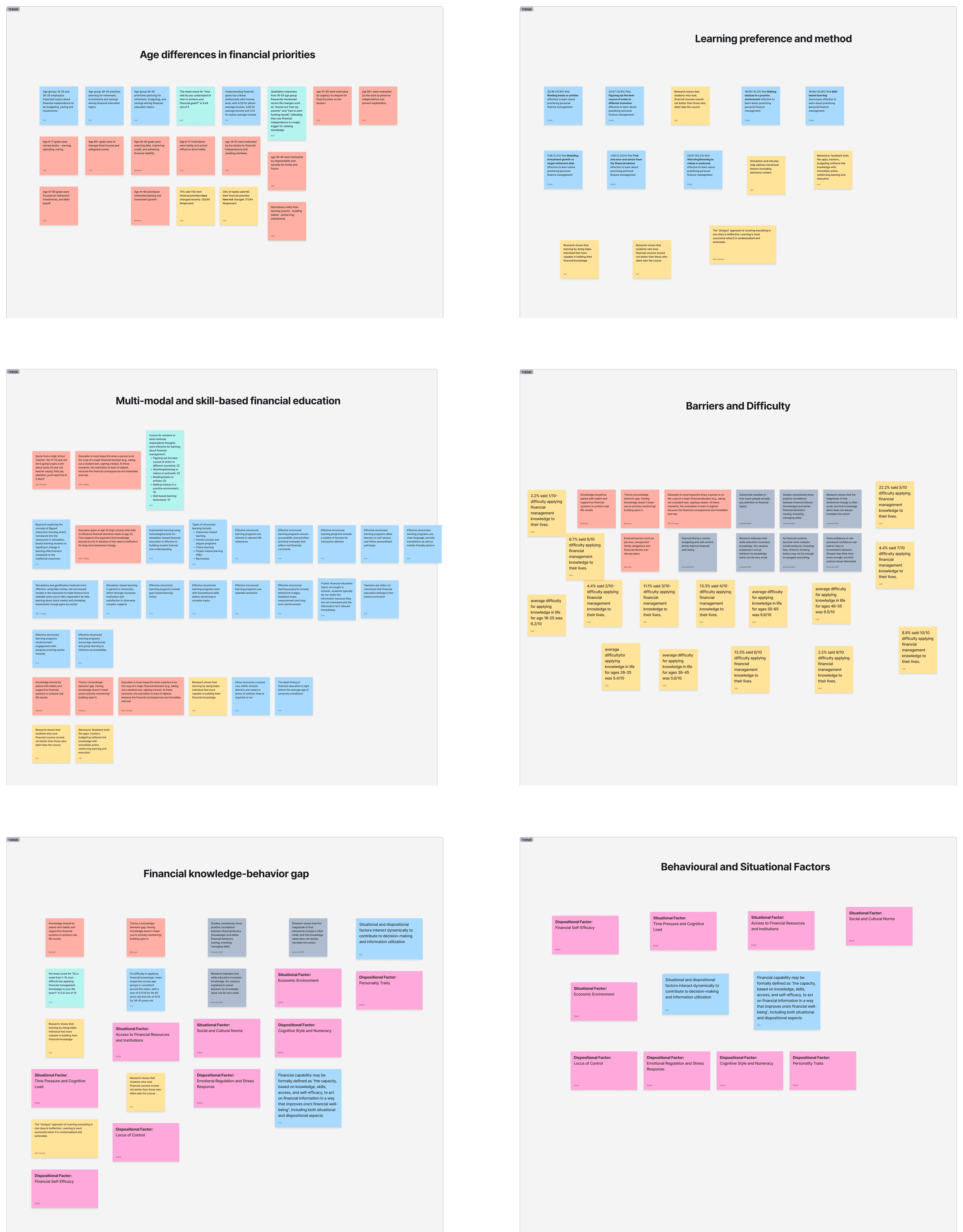
Highest and Lowest Potential Engagement by Age Group
Highest and Lowest Potential Engagement by Age Group


ASSUMPTION TESTING & DEEPER RESEARCH INSIGHT
ASSUMPTION TESTING & DEEPER RESEARCH INSIGHT
Design Sprint 3 & 4
Design Sprint 3 & 4
After initial insights from user research and the first sprint, we identified new questions and unresolved opportunities.
After the first round of research, we gained a high-level understanding of how students perceive financial responsibility
and learning.
However, key questions remained unanswered:
What specific financial topics do students actively seek out?
What prevents them from learning, even when they are motivated?
How do students prefer to consume financial education today?
To explore these questions in more depth, we conducted a second design sprint focused on content relevance, learning barriers, and engagement formats.
After initial insights from user research and the first sprint, we identified new questions and unresolved opportunities.
After the first round of research, we gained a high-level understanding of how students perceive financial responsibility
and learning.
However, key questions remained unanswered:
What specific financial topics do students actively seek out?
What prevents them from learning, even when they are motivated?
How do students prefer to consume financial education today?
To explore these questions in more depth, we conducted a second design sprint focused on content relevance, learning barriers, and engagement formats.
Sprint Goal
Sprint Goal
To identify what students want to learn, why learning is difficult, and how financial education can be delivered in a way that feels engaging and accessible. We prioritized research topics based on risk and certainty, based on results from our first round of surveys.
To identify what students want to learn, why learning is difficult, and how financial education can be delivered in a way that feels engaging and accessible. We prioritized research topics based on risk and certainty, based on results from our first round of surveys.

Research Questions
Research Questions
Which personal finance topics feel most relevant to students right now?
What emotional, practical, or systemic barriers prevent learning?
What makes the information easy to consume, well structured, and less chaotic?
How can we explore the relationship between financial knowledge (cognitive understanding) and financial responsibility (behavioral application)?
How can we examinine why some young adults with knowledge still struggle with responsible financial behaviors?
Which personal finance topics feel most relevant to students right now?
What emotional, practical, or systemic barriers prevent learning?
What makes the information easy to consume, well structured, and less chaotic?
How can we explore the relationship between financial knowledge (cognitive understanding) and financial responsibility (behavioral application)?
How can we examinine why some young adults with knowledge still struggle with responsible financial behaviors?
We created Research Topics from our initial Research Questions:
We created Research Topics from our initial Research Questions:
What financial barriers do lower income populations face, and how can they overcome those barriers?
1
What financial barriers do lower income populations face, and how can they overcome those barriers?
1
How do user’s age, social status, and financial goals influence the type fo financial information they value most?
2
How do user’s age, social status, and financial goals influence the type fo financial information they value most?
2
What makes financial information clear and easy to consume.
3
What makes financial information clear and easy to consume.
3
What is the relationship between financial knowledge and financial responsibility?
4
What is the relationship between financial knowledge and financial responsibility?
4
We created Research Goals for the Research Topics:
We created Research Goals for the Research Topics:
Explore what blockers the users have with financial education.
1
Explore what blockers the users have with financial education.
1
We will have a clear understanding of which financial information (i.e saving, investing, budgeting, etc) matters most to different demographics, including how our user’s goals influence their needs.
2
We will have a clear understanding of which financial information (i.e saving, investing, budgeting, etc) matters most to different demographics, including how our user’s goals influence their needs.
2
Explore how various information and how they are presented affects users understanding.
3
Explore how various information and how they are presented affects users understanding.
3
Find out if financial knowledge will have an impact on financial behaviors.
4
Find out if financial knowledge will have an impact on financial behaviors.
4
Assumption Table
Assumption Table
Based on insights from our initial research and the second design sprint, we surfaced a set of assumptions about students’ financial learning behaviors, motivations, and barriers. Rather than treating these assumptions as truths, we used them as hypotheses to test during the second design sprint. This helped us focus our research, challenge biases, and avoid designing solutions based on unvalidated beliefs.
Based on insights from our initial research and the second design sprint, we surfaced a set of assumptions about students’ financial learning behaviors, motivations, and barriers. Rather than treating these assumptions as truths, we used them as hypotheses to test during the second design sprint. This helped us focus our research, challenge biases, and avoid designing solutions based on unvalidated beliefs.


Prioritization Matrix
Prioritization Matrix
As the volume of research insights grew, a prioritization matrix was used to synthesize findings and guide decision-making. By mapping opportunities against user impact and feasibility, we were able to move from exploration toward intentional focus. The matrix revealed that the highest-priority opportunities were those that supported real-life financial decision-making, reduced emotional friction, and encouraged small, repeatable actions rather than long-term commitment or theoretical learning.
As the volume of research insights grew, a prioritization matrix was used to synthesize findings and guide decision-making. By mapping opportunities against user impact and feasibility, we were able to move from exploration toward intentional focus. The matrix revealed that the highest-priority opportunities were those that supported real-life financial decision-making, reduced emotional friction, and encouraged small, repeatable actions rather than long-term commitment or theoretical learning.

Primary Research Assumptions
Primary Research Assumptions

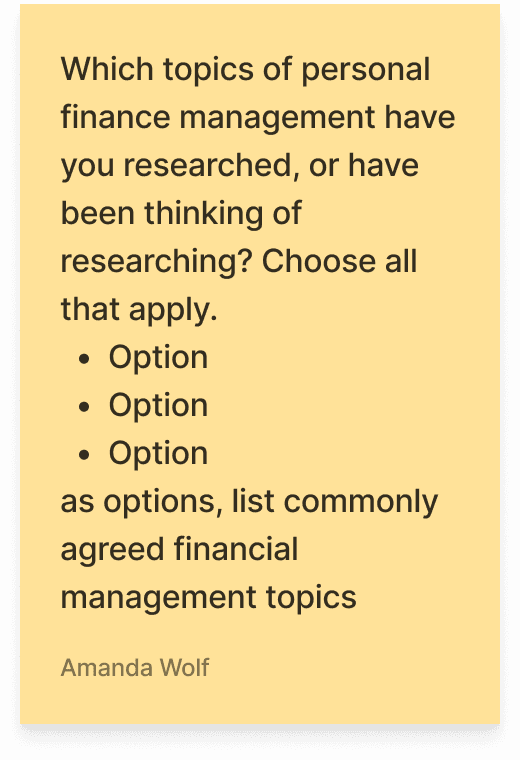



Primary Research Questions:
What kind of financial knowledge do you think you need and would help you the most?
What type of financial resources would be most beneficial to you in your current situation?
What type of information or resources would you benefit most from financially?
What aspects of financial management do you find most relevant to you?
What financial tools do currently align with your goals?
What was one thing that put you off learning personal finance management?
What barriers could you face while trying to start learning about finance?
What financial information or guidance have you received in school?
Can you recall the time you looked for necessary financial management information, found it and got easily engaged with the topic?
How do you prefer to learn? community workshops and seminars, videos or social media?
What influences your financial goals the most (i.e income, mindset, age, taste, etc)?
Primary Research Questions:
What kind of financial knowledge do you think you need and would help you the most?
What type of financial resources would be most beneficial to you in your current situation?
What type of information or resources would you benefit most from financially?
What aspects of financial management do you find most relevant to you?
What financial tools do currently align with your goals?
What was one thing that put you off learning personal finance management?
What barriers could you face while trying to start learning about finance?
What financial information or guidance have you received in school?
Can you recall the time you looked for necessary financial management information, found it and got easily engaged with the topic?
How do you prefer to learn? community workshops and seminars, videos or social media?
What influences your financial goals the most (i.e income, mindset, age, taste, etc)?
Primary Research Questions:
What kind of financial knowledge do you think you need and would help you the most?
What type of financial resources would be most beneficial to you in your current situation?
What type of information or resources would you benefit most from financially?
What aspects of financial management do you find most relevant to you?
What financial tools do currently align with your goals?
What was one thing that put you off learning personal finance management?
What barriers could you face while trying to start learning about finance?
What financial information or guidance have you received in school?
Can you recall the time you looked for necessary financial management information, found it and got easily engaged with the topic?
How do you prefer to learn? community workshops and seminars, videos or social media?
What influences your financial goals the most (i.e income, mindset, age, taste, etc)?
Secondary Research Assumptions
Secondary Research Assumptions


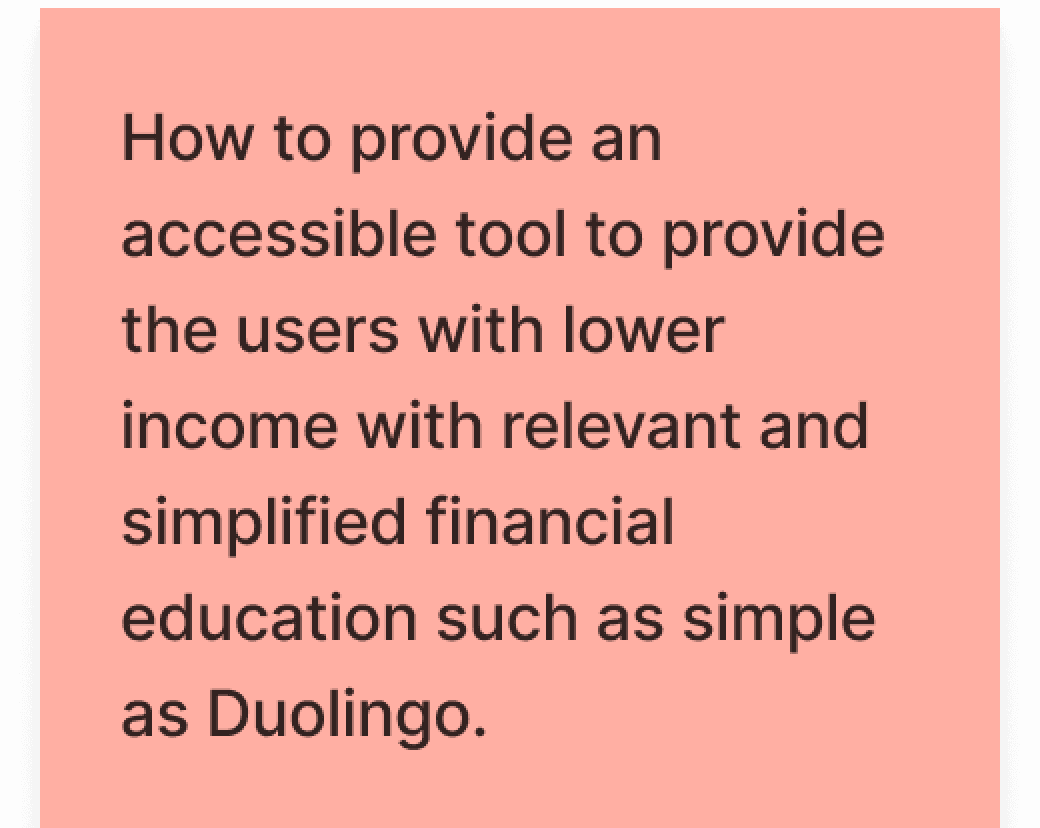

Secondary Research Questions:
What are the most effective financial literacy programs or gamified learning tools currently available?
What UX patterns do successful educational apps (e.g., Duolingo, Kahoot!, Quizlet) use to sustain engagement and motivation?
What data exists on youth financial literacy rates, motivation, and learning preferences?
What pedagogical approaches make complex financial topics accessible and engaging for young learners?
What barriers prevent beginners from knowing where or how to start learning about personal finance?
What gaps or criticisms exist in current financial education methods, both in schools and online?
Secondary Research Questions:
What are the most effective financial literacy programs or gamified learning tools currently available?
What UX patterns do successful educational apps (e.g., Duolingo, Kahoot!, Quizlet) use to sustain engagement and motivation?
What data exists on youth financial literacy rates, motivation, and learning preferences?
What pedagogical approaches make complex financial topics accessible and engaging for young learners?
What barriers prevent beginners from knowing where or how to start learning about personal finance?
What gaps or criticisms exist in current financial education methods, both in schools and online?
Secondary Research Questions:
What are the most effective financial literacy programs or gamified learning tools currently available?
What UX patterns do successful educational apps (e.g., Duolingo, Kahoot!, Quizlet) use to sustain engagement and motivation?
What data exists on youth financial literacy rates, motivation, and learning preferences?
What pedagogical approaches make complex financial topics accessible and engaging for young learners?
What barriers prevent beginners from knowing where or how to start learning about personal finance?
What gaps or criticisms exist in current financial education methods, both in schools and online?
RESERACH REFINEMENT, VALIDATION & SYNTHESIS
RESERACH REFINEMENT, VALIDATION & SYNTHESIS
Concept Refinement & Synthesis
Concept Refinement & Synthesis
The final two design sprints focused on refining and validating the emerging direction. Rather than introducing new problem areas, these sprints helped consolidate insights, stress-test assumptions, and sharpen the focus of the solution space. The final sprint (Sprint 4) was no longer about discovering the problem, but about confirming, sharpening, and stress-testing earlier insights.
The final two design sprints focused on refining and validating the emerging direction. Rather than introducing new problem areas, these sprints helped consolidate insights, stress-test assumptions, and sharpen the focus of the solution space. The final sprint (Sprint 4) was no longer about discovering the problem, but about confirming, sharpening, and stress-testing earlier insights.
Process
Process
Building on insights from previous sprints, we combined quantitative survey data, qualitative feedback, and secondary research to stress-test assumptions and clarify the core problem space.
Building on insights from previous sprints, we combined quantitative survey data, qualitative feedback, and secondary research to stress-test assumptions and clarify the core problem space.
Validation
Confirms earlier insight that financial learning is most effective when contextual and timely.

Reflection
This shifts the design focus from education delivery to decision support and behavioral reinforcement.

Synthesis
Interactive tools must reflect real-world constraints, not idealized financial behavior.

Design Implication
Tools should support ongoing guidance, not assume linear progression or mastery.

Sprint Validation
Sprint Validation
By the end of the fourth sprint, our focus shifted from designing educational content to designing interactive decision-making support. “Fun” became less about gamification and more about clarity, confidence, and control in real financial moments.
By the end of the fourth sprint, our focus shifted from designing educational content to designing interactive decision-making support. “Fun” became less about gamification and more about clarity, confidence, and control in real financial moments.

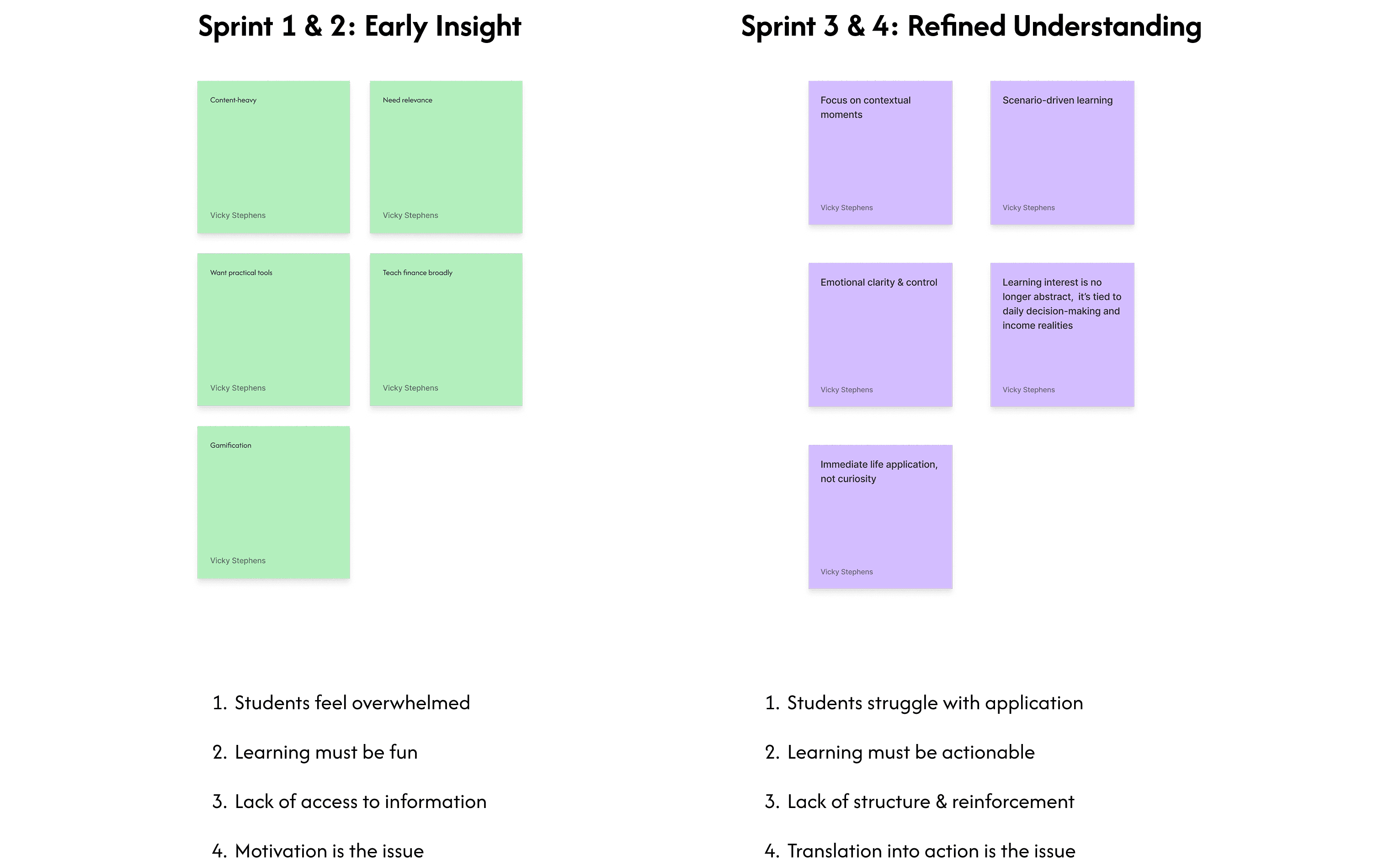
Sprint 3 & 4: Refined Understanding

Students struggle with application
Learning must be actionable
Lack of structure & reinforcement
Translation into action is the issue
Sprint 1 & 2: Early Insight

Students feel overwhelmed
Learning must be fun
Lack of access to information
Motivation is the issue
Sprint 1 & 2: Early Insight
Students feel overwhelmed
Learning must be fun
Lack of access to information
Motivation is the issue
Sprint 3 & 4: Refined Understanding
Students struggle with application
Learning must be actionable
Lack of structure & reinforcement
Translation into action is the issue
Concept Reflection
Concept Reflection
Reflecting on early concept directions revealed a shift in how “engagement” was defined. Initial ideas leaned toward making financial learning entertaining, but research consistently showed that people valued clarity, applicability, and control over novelty.
Reflecting on early concept directions revealed a shift in how “engagement” was defined. Initial ideas leaned toward making financial learning entertaining, but research consistently showed that people valued clarity, applicability, and control over novelty.
Topic Interest Became More Practical & Action-Oriented
Topic Interest Became More Practical & Action-Oriented
Sprint 2:
Students broadly wanted to “learn finance” and named many topics.
Sprint 4:
Students consistently selected:
Budgeting
Saving
Debt management
Investing
…but now framed through immediate life application, not curiosity.
Key shift:
Learning interest is no longer abstract, it’s tied to daily decision-making and income realities. This validates your earlier assumption that relevance > entertainment.

Barriers Shifted from “Not Knowing” to “Applying”
Barriers Shifted from “Not Knowing” to “Applying”
Sprint 4 introduces an important refinement:
Students don’t struggle as much with accessing information as they do with applying it consistently.
Evidence:
Low to moderate difficulty scores when understanding finance
Higher friction when applying knowledge to real life
New insight (very strong):
The core UX problem is not education, it’s translation into action. This is a major synthesis moment.

Decision-Making Is Governed by Constraints, Not Motivation
Decision-Making Is Governed by Constraints, Not Motivation
Sprint 4 responses around saving vs spending show patterns:
Monthly limits
Income level
Size/urgency of purchase
Avoidance of large expenses
What’s different from Sprint 2:
Less emotional language
More constraint-based reasoning
Refined insight:
Financial decisions are made within rigid personal systems, not flexible mindsets. Tools must work within those systems. This strongly supports scenario-based and simulation tools.

Confidence Levels Are Higher Than Expected
Confidence Levels Are Higher Than Expected
Sprint 2 suggested insecurity and overwhelm.
Sprint 4 shows:
Many respondents rate themselves low difficulty (1–3) in applying finance
Yet still show inconsistent behaviors
Important synthesis:
Confidence does not equal consistency. This helps us avoid designing for “beginners only” and supports adaptive or progressive tools.

Research Synthesis
Research Synthesis
Insights from primary research were synthesized alongside secondary research and affinity mapping to identify consistent themes across data sources. This synthesis revealed that financial learning challenges are less about access to information and more about translating knowledge into action. Emotional friction, lack of structure, and real-world constraints emerged as recurring factors influencing financial behavior.
Insights from primary research were synthesized alongside secondary research and affinity mapping to identify consistent themes across data sources. This synthesis revealed that financial learning challenges are less about access to information and more about translating knowledge into action. Emotional friction, lack of structure, and real-world constraints emerged as recurring factors influencing financial behavior.
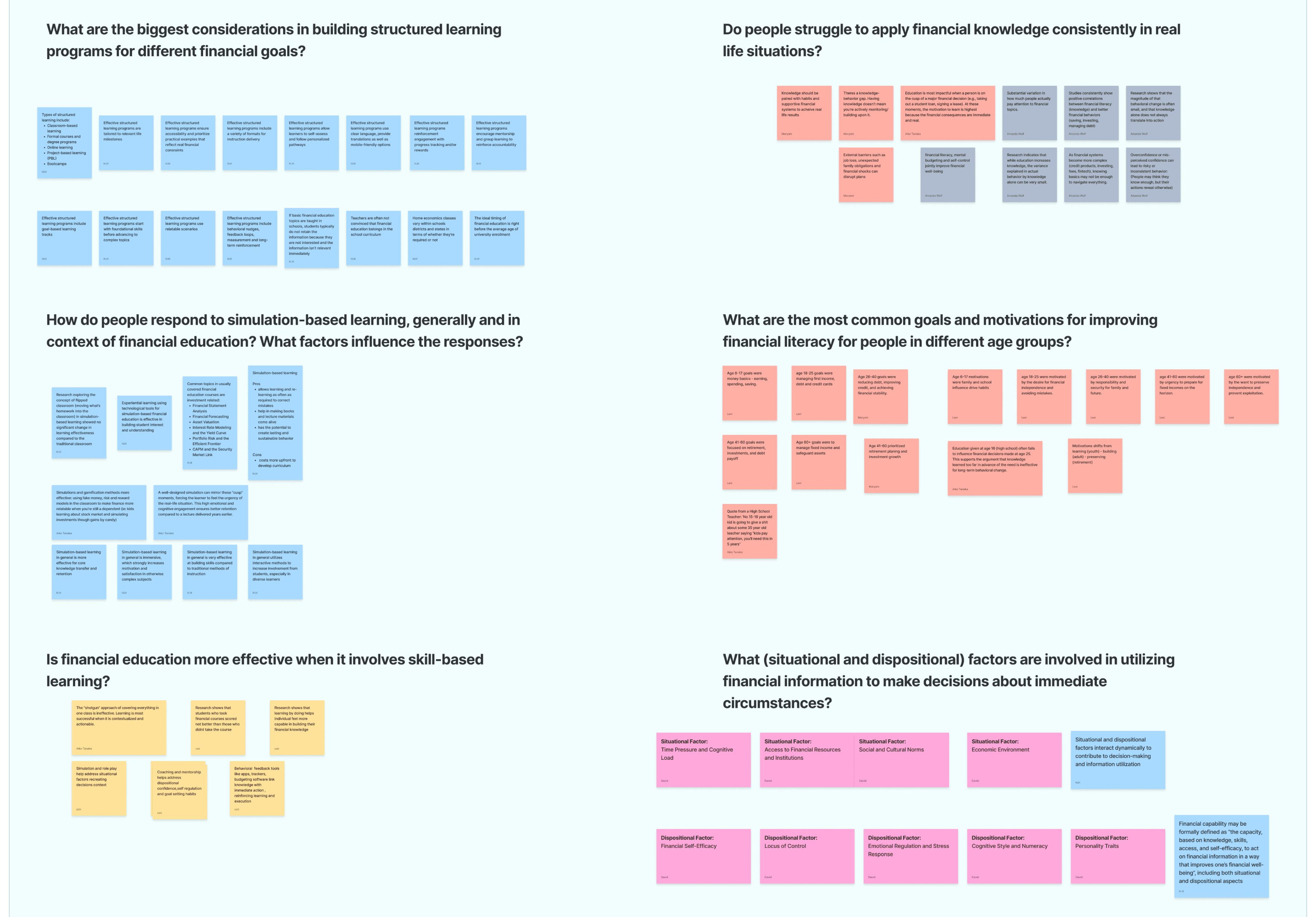
Affinity Mapping
Affinity Mapping


Affinity Mapping
Design Implication
Design Implication
The synthesis of findings led to clear design implications: financial learning tools should prioritize contextual, scenario-based interactions over static content; support decision-making within real constraints; and reduce emotional friction through clarity and guidance.
Rather than teaching finance in isolation, effective tools should integrate learning into moments where decisions naturally occur.
The synthesis of findings led to clear design implications: financial learning tools should prioritize contextual, scenario-based interactions over static content; support decision-making within real constraints; and reduce emotional friction through clarity and guidance.
Rather than teaching finance in isolation, effective tools should integrate learning into moments where decisions naturally occur.
Focus on Foundational Financial Literacy and Moderate Difficulty in Application
The most requested topics for financial education are the fundamentals, while respondents generally find the practical application of financial knowledge to be moderately challenging.
Top Educational Priorities:
The majority of respondents prioritized fundamental topics like Budgeting (35 mentions), Savings (34 mentions), and Investments (25 mentions) as the most important things for adults to learn before becoming financially independent.
This suggests a strong, widespread need for foundational financial literacy before moving on to more complex areas like retirement planning or managing debt.
Moderate Difficulty in Application:
The average difficulty score for applying financial management knowledge to life is 5.37 (median is 5.0) on a 1-10 scale. Most respondents marked their difficulty in the mid-range, with 14 people selecting a score of 5, indicating that for many, there is a moderate challenge in translating knowledge into practical results.
Understanding by Age:
Generally, older age groups report a slightly higher self-assessed understanding of how to achieve their financial goals, with the 36-45 and 46-55 age ranges reporting the highest average score of 4.0 (on a likely 1-5 scale, inferred from the data), compared to the 18-25 age range with an average of 3.15.
Digital and Practical Methods are Key to Effective Learning:
Respondents find self-directed and hands-on learning methods to be the most effective for personal finance management.
Top Learning Methods are Digital: The most cited effective methods are self-directed and readily available: Watching/listening to videos or podcasts (27 mentions) and Reading books or articles (23 mentions).
Importance of Practical Application:
Close behind the digital methods are hands-on, practical learning approaches: Figuring out the best course of action in different scenarios (23 mentions) and Making choices in a practice environment (21 mentions). This suggests that educational efforts should combine accessible content with opportunities for practical, low-stakes decision-making.

Design Sprint Insights
Design Sprint Insights
The updated analysis confirms the validity of the core assumptions regarding the need for skill-based, practical financial education and the importance of addressing scarcity and risk for low-income individuals
The data also validates that users know their priorities, which are overwhelmingly Budgeting and Savings.
The exploratory analysis highlights that:
Confidence is Income-Dependent: Financial goal understanding is significantly higher for the Above Average income group.
Priorities are Age-Dependent: Learning priorities shift predictably from foundational skills (younger adults) to future-focused topics (middle-aged adults) and back to management/preservation (older adults).
The updated analysis confirms the validity of the core assumptions regarding the need for skill-based, practical financial education and the importance of addressing scarcity and risk for low-income individuals
The data also validates that users know their priorities, which are overwhelmingly Budgeting and Savings.
The exploratory analysis highlights that:
Confidence is Income-Dependent: Financial goal understanding is significantly higher for the Above Average income group.
Priorities are Age-Dependent: Learning priorities shift predictably from foundational skills (younger adults) to future-focused topics (middle-aged adults) and back to management/preservation (older adults).
MODEL FOR MITIGATING FINANCIAL ISSUES
MODEL FOR MITIGATING FINANCIAL ISSUES
The User Profile
The User Profile
We did a total of four design sprints, which allowed us to validate and refine several of our initial assumptions. While interest in financial learning was high, findings revealed that emotional overwhelm and lack of structure were bigger barriers than motivation itself.
Based on research, I developed archetypes and mapped key financial moments such as receiving income or running out of money, to uncover intervention opportunities. By determining users' wants, behaviors, likes and dislikes, we prioritized certain needs that we would later design for.
We did a total of four design sprints, which allowed us to validate and refine several of our initial assumptions. While interest in financial learning was high, findings revealed that emotional overwhelm and lack of structure were bigger barriers than motivation itself.
Based on research, I developed archetypes and mapped key financial moments such as receiving income or running out of money, to uncover intervention opportunities. By determining users' wants, behaviors, likes and dislikes, we prioritized certain needs that we would later design for.
User Statements
User Statements
The following user statements were synthesized from patterns observed across multiple research sprints. They represent recurring needs, behaviors, and frustrations that informed potential user archetypes and future journey mapping.
The following user statements were synthesized from patterns observed across multiple research sprints. They represent recurring needs, behaviors, and frustrations that informed potential user archetypes and future journey mapping.

Archetypes
Archetypes
These archetypes were developed by synthesizing behavioral patterns, emotional responses, and recurring pain points identified across multiple research sprints. They were used to guide journey mapping and explore how an interactive financial learning tool could support students at different stages of confidence, motivation, and engagement.
These archetypes were developed by synthesizing behavioral patterns, emotional responses, and recurring pain points identified across multiple research sprints. They were used to guide journey mapping and explore how an interactive financial learning tool could support students at different stages of confidence, motivation, and engagement.

User Journey Highlights
User Journey Highlights
Mapping the student’s financial learning journey revealed multiple points where engagement breaks down, not due to lack of interest, but due to emotional and contextual barriers. These moments informed our design opportunities and guided how an interactive tool could better support real-world financial decision-making. We scoped the MVP down to three main insights:
Mapping the student’s financial learning journey revealed multiple points where engagement breaks down, not due to lack of interest, but due to emotional and contextual barriers. These moments informed our design opportunities and guided how an interactive tool could better support real-world financial decision-making. We scoped the MVP down to three main insights:
Learning is triggered by real-life financial stress
Students seek financial knowledge when faced with immediate problems.
Abstract concepts limit engagement
Students struggle with financial theory unless paired with real-world scenarios.
Autonomy increases motivation
Students prefer tools that allow exploration and experimentation rather than prescriptive lessons.

REFLECTION
REFLECTION
What I learned
What I learned
While the research initially focused on students, findings revealed that the core challenges were less about academic status and more about navigating early financial independence. This insight expanded the scope to include young adults in transitional life stages who are beginning to manage real-world financial responsibilities.
Through this process, I gained a deeper appreciation for the role of UX research in uncovering behavioral patterns and emotional barriers that are not immediately visible through assumptions alone. These insights will inform the next phase of the project, which will explore competitor and market research to understand how existing tools address, or fail to address these needs.
This project reinforced my belief that design is not about simplifying reality, but about making complexity approachable, supportive, and humane.
While the research initially focused on students, findings revealed that the core challenges were less about academic status and more about navigating early financial independence. This insight expanded the scope to include young adults in transitional life stages who are beginning to manage real-world financial responsibilities.
Through this process, I gained a deeper appreciation for the role of UX research in uncovering behavioral patterns and emotional barriers that are not immediately visible through assumptions alone. These insights will inform the next phase of the project, which will explore competitor and market research to understand how existing tools address, or fail to address these needs.
This project reinforced my belief that design is not about simplifying reality, but about making complexity approachable, supportive, and humane.